
A major counterterrorism operation is making headlines worldwide after former U.S. President Donald Trump claimed that American forces, working alongside the Nigerian military, successfully eliminated one of the world’s most wanted ISIS leaders.
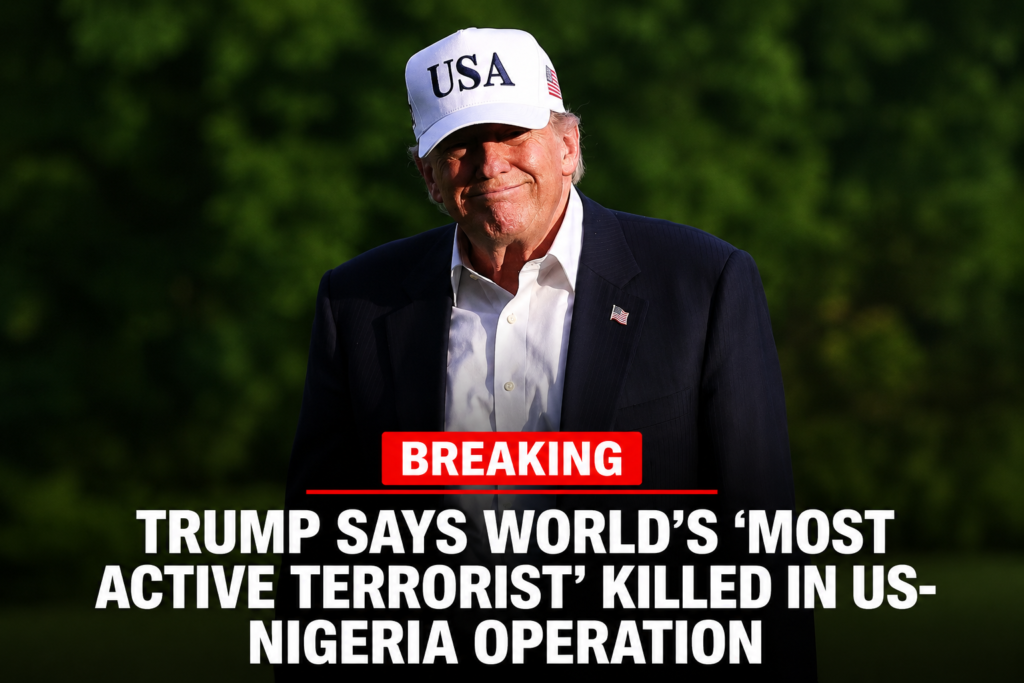
In a late-night post shared on Truth Social, Trump announced that Abu-Bilal al-Minuki, described as ISIS’s second-in-command globally and “the most active terrorist in the world,” was killed during a highly coordinated mission in Africa.
According to Trump, the operation involved intelligence tracking, surveillance, and joint military coordination between U.S. forces and Nigeria’s security agencies. He stated that the terror leader believed he could remain hidden in Africa, but intelligence sources allegedly monitored his movements closely for an extended period.
“[He] thought he could hide in Africa,” Trump wrote, “but little did he know we had sources who kept us informed on what he was doing.”
The announcement has quickly sparked reactions across global media, security communities, and political circles, with many waiting for official confirmation and additional operational details from U.S. defense officials and Nigerian authorities.
Who Was Abu-Bilal al-Minuki?
Abu-Bilal al-Minuki was reportedly a senior ISIS commander linked to extremist operations across parts of Africa and the Middle East. Security analysts have described him as a key figure involved in recruitment, financing, planning attacks, and expanding ISIS influence throughout vulnerable regions.
If confirmed, his death could mark a significant blow to ISIS operations and terror networks operating across Africa, especially in areas already facing insurgency threats and regional instability.
Nigeria’s Role in the Operation
Nigeria has spent years battling extremist groups, including ISIS-affiliated organizations and other insurgent movements in the northern region of the country. Joint operations involving international intelligence support have become increasingly important in counterterrorism missions.
The reported collaboration between U.S. military forces and Nigerian troops highlights growing security cooperation aimed at combating global terrorism and preventing extremist expansion across Africa.
Military experts say such operations often rely heavily on intelligence gathering, satellite monitoring, local informants, and rapid tactical deployment to successfully target high-ranking terror leaders.
Global Reactions Begin to Surface
The announcement immediately generated global attention online, with supporters praising the operation as a major victory against terrorism, while others called for independent verification and official military briefings.
Security observers are also watching closely to see how ISIS-linked groups may respond following the reported death of one of their top commanders.
As more information emerges, governments and intelligence agencies around the world are expected to monitor potential security implications connected to the operation.
Why This Story Matters
The reported killing of a senior ISIS figure underscores the continuing global fight against terrorism and the growing strategic importance of Africa in international security operations. It also highlights how modern intelligence networks and international military partnerships are shaping counterterrorism efforts worldwide.
If verified by official defense agencies, this operation could become one of the most significant anti-ISIS missions reported in recent months.